Paramètres d’accessibilité

Reading and Understanding the Same Scriptures?
05 July 2027 07 July 2027Reading and Understanding the Same Scriptures? Texts, Translations, Interpretations, and Controversies in Early Christianity
Description
À partir d'études précises portant sur les traditions grecque, latine, syriaque, copte, arménienne et géorgienne, il étudiera l'usage théologique des variantes ainsi que l'influence possible des controverses sur la traduction, la révision et la transmission des Écritures. Il interrogera ainsi ce que signifiait, pour les communautés chrétiennes anciennes, lire « les mêmes Écritures » malgré la diversité des textes, des langues et des interprétations.
Afin de réunir les intervenants intéressés et d'affiner ensemble la problématique du colloque, deux rencontres Teams seront proposées : une première en novembre, pour confronter les premières pistes et préciser les axes de travail, puis une seconde en mars, pour mettre en commun l'avancement des contributions, resserrer la problématique commune et préparer l'articulation du colloque.
Description
Lire et comprendre les mêmes Écritures ? Textes, traductions, interprétations et controverses dans le christianisme ancien
ARGUMENTAIRE
Entre le IVe et le VIe siècle, les grandes controverses théologiques se développent au sein de de communautés ecclésiales qui reconnaissent les mêmes Écritures comme autorité, sans toujours disposer exactement du même état du texte ni des mêmes traductions (Ayres, 2004 ; Hanson, 1988 ; Young et Teal, 2010 ; McGuckin, 1994). Cette situation résulte en partie d'une histoire antérieure : le Nouveau Testament a circulé en grec sous plusieurs formes et a été traduit très tôt en latin, en syriaque et en copte, puis en arménien et en géorgien. Ces versions ne reposent pas nécessairement sur les mêmes modèles grecs et connaissent elles-mêmes des révisions et des recensions (Parker, 2008 ; Metzger, 1977 ; Cowe, 2012 ; Childers, 2012).
Centré sur les IVe–VIe siècles, avec des remontées ponctuelles aux IIe–IIIe siècles, le colloque interrogera la rencontre entre cette pluralité textuelle et linguistique et la formation des doctrines chrétiennes : Comment une variante, une traduction ou une révision devient-elle théologiquement signifiante ? Les controverses peuvent-elles influer sur la traduction, la révision ou la transmission de l'Écriture ? Il s'agira de croiser critique textuelle, histoire des versions, patristique et histoire des doctrines autour d'une même question : que signifie, dans l'Antiquité chrétienne, lire « les mêmes Écritures » ?
Description
This conference invites contributions presenting case studies that will enable us to examine how variants in biblical texts and the diversity of their translations may, to varying degrees, have shaped interpretation and doctrinal controversies in early Christianity, particularly from the fourth to the sixth century.
Through focused studies of the Greek, Latin, Syriac, Coptic, Armenian, and Georgian traditions, we will investigate the theological use of textual variants, as well as the possible influence of doctrinal controversies on the translation, revision, and transmission of Scripture.
The conference will thus seek to determine what it meant for early Christian communities to read 'the same Scriptures' despite the diversity of texts, languages, and interpretations.
Reading and Understanding the Same Scriptures? Texts, Translations, Interpretations, and Controversies in Early Christianity
Introduction
Between the fourth and seventh centuries, major theological controversies developed within ecclesiastical communities that recognized the authority of the same Scriptures, although they did not always possess precisely the same forms of the text or the same translations (Ayres, 2004; Hanson, 1988; Young and Teal, 2010; McGuckin, 1994). This situation resulted partly from earlier developments: the New Testament circulated in Greek in several forms and was translated at an early stage into Latin, Syriac, and Coptic, and subsequently into Armenian and Georgian. These versions were not necessarily based on the same Greek exemplars and themselves underwent revisions and recensions (Parker, 2008; Metzger, 1977; Cowe, 2012; Childers, 2012).
Focusing on the fourth to sixth centuries, with occasional references to the second and third centuries, the conference will explore the relationship between this textual and linguistic plurality and the development of Christian doctrines. How does a textual variant, translation, or revision acquire theological significance? Can doctrinal controversies influence the translation, revision, or transmission of Scripture? The aim is to bring together textual criticism, the history of biblical versions, patristics, and the history of doctrine around a common question: what did it mean to read 'the same Scriptures' in Christian antiquity?
- One Scripture, but in What Forms?
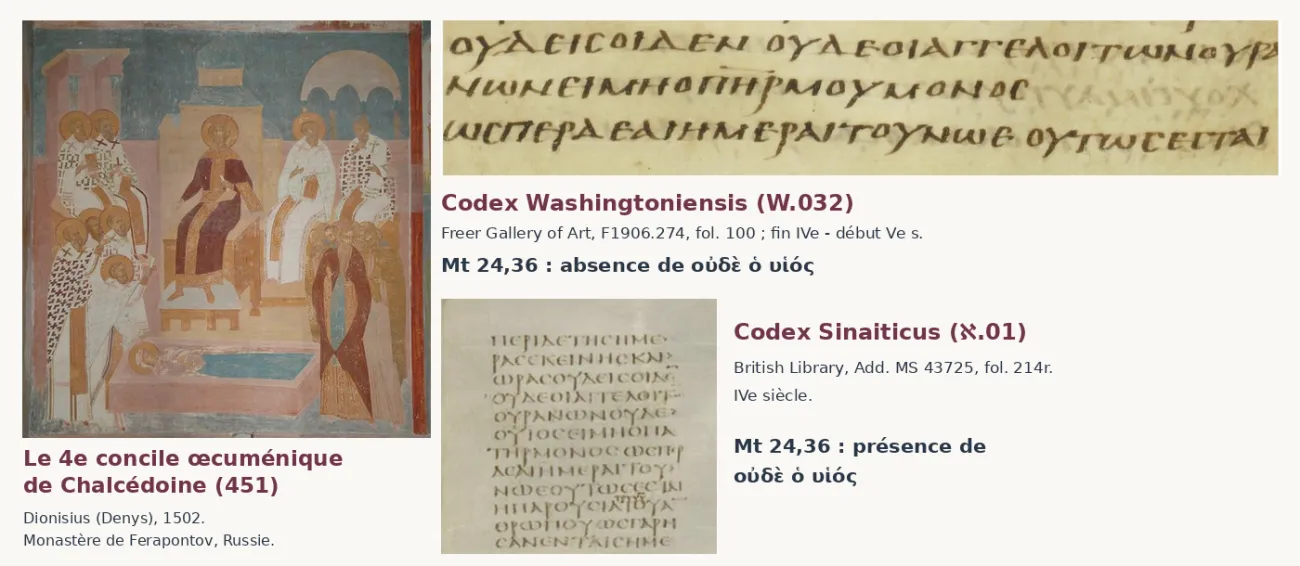
From the second to the fourth century, and in some languages as late as the seventh century, the Scriptures were transmitted in forms that could differ because of distinct copying and translation traditions (Parker, 2008; Metzger, 1977). The variants in Matt. 24:36, Mark 1:1, and Luke 22:43–44 have been discussed in connection with Christological issues: the knowledge of the Son, the identity of Christ, and the reality of his humanity and suffering. Yet the connection between each variant and the doctrinal controversies is not equally well documented (Metzger, 1994; Wallace, 2015; Head, 1991; Blumell, 2014).
Doctrines do not emerge mechanically from the existence of variants that would account for them, and doctrinal controversies may themselves have influenced the transmission and interpretation of the text (Ehrman, 1993; Parker, 2008). In light of the debates prompted by Nicaea and its reception, followed by controversies concerning the unity of Christ, the relationship between divinity and humanity, and the reception of Ephesus and Chalcedon, the aim will be to examine cases in which a textual difference, whether in Greek or in a translated version, was demonstrably used in theological argumentation, as well as cases in which controversy appears to have contributed to a revision or a particular form of textual transmission (Ayres, 2004; Hanson, 1988; Young and Teal, 2010; McGuckin, 1994).
- From Textual Plurality to Stabilization
The history of doctrine must therefore be situated within the material history of the Scriptures. Origen was aware of, and explicitly noted, divergent readings in manuscripts (Comm. in Matt. XV,14) (Metzger, 1968 ; Donaldson, 2009). His work, first in Alexandria and then in Caesarea, raises questions about the collections to which an ancient author could have had access and the opportunities available to compare different forms of the same text (Grafton and Williams, 2006; Inowlocki, 2024).
In the fourth century, during the decades following Nicaea, large biblical codices appeared, including Codex Vaticanus (Vatican, BAV, Vat. gr. 1209) and Codex Sinaiticus (London, British Library, Add MS 43725) (Parker, 2008; Amphoux, 2013). At the same time, collections are attested in certain centers, particularly Caesarea, where they are associated with Pamphilus and Eusebius (Grafton and Williams, 2006; Inowlocki, 2024). Accordingly, without assuming a uniform process of standardization, we may ask how certain textual forms acquired wider circulation and greater authority, and to what extent theological controversies played a role in this process.
- Textual Instability and Doctrinal Development
As particular forms of the New Testament text gradually gained prominence in certain regions and traditions, attention shifted toward the theological use of these textual forms (Parker, 2008; Ehrman and Holmes, 2013). Controversies could arise over passages containing significant variants, and differences in wording could acquire particular doctrinal significance depending on how sonship, generation, divinity, the Incarnation, and the Passion, death, and Resurrection were understood (Ayres, 2004; Hanson, 1988; McGuckin, 1994). Treatises, homilies, letters, conciliar acts, and ecclesiastical histories will therefore be considered insofar as they provide evidence for the use of a particular textual form, translation, or revision of Scripture.
Even when the text tended toward stabilization, surviving variants could continue to receive competing interpretations within doctrinal controversies (Fogleman and Brumback, 2026). Their significance depended not only on the reading attested but also on how it was understood and employed in theological argumentation.
- The importance of Early Versions
Greek remained the principal language of reference for the New Testament and many theological controversies, but the Scriptures were translated at an early stage into Latin, Syriac, and Coptic, and subsequently into Armenian and Georgian (Amphoux, 2014). These translations did not always derive from the same form of the Greek text and had their own histories of revision (Metzger, 1977; Cowe, 2012; Childers, 2012).
In the Latin tradition, several cases suggest that textual variants were used for doctrinal purposes. In John 1:13, Tertullian (De carne Christi 19) defends the singular natus est, referring to Christ, against nati sunt, referring to the believers of John 1:12, which he presents as a corruption intended to support the Valentinian interpretation of the spiritual elect (Jansen, 1982; Houghton, 2016; de Lamarzelle, 2021). Matt. 24:36 offers another example: in De fide ad Gratianum 5.16.193, Ambrose states that the words οὐδὲ ὁ υἱός are absent from ancient Greek manuscripts and accuses his opponents of having altered the text in the context of the Arian controversy concerning the knowledge and divinity of the Son. In Marius Victorinus, the relationship with Greek emerges primarily through variation in translation: ἐν κόλπῳ is rendered in gremio rather than in sinu in John 1:18 (Adv. Ar. 4.33); πρὸς τὸν θεόν in John 1:1 is variously rendered circa Deum, ad Deum, apud Deum, or iuxta Deum; οὐδείς in John 1:18 is translated nullus or nemo; and John 4:14 fluctuates between efficietur in ipso fons aquae scatentis (Adv. Ar. 1.5) and fiet in eo fons aquae salientis (4.6). These variations raise the question of whether Victorinus was quoting several forms of the Latin biblical text or translating an underlying Greek form himself (Houghton, 2013; 2016; Lössl, 2021).
The Syriac tradition also provides variants capable of generating Christological controversies. From the second century onward, the circulation of the Diatessaron had a lasting impact on the transmission of the Gospels (Petersen, 1994); in the fourth and fifth centuries, the Curetonian and Sinaitic versions still attest textual plurality prior to the Peshitta (Haelewyck, 2019). The Philoxenian version of 507/508 and the Harklean version of 615/616 revised the text on the basis of Greek, the latter preserving numerous variants in its margins (Kiraz, 1996; Brock, 2021). These revisions, which bear witness to textual variants, could in turn generate theological debate when received by different communities. Thus, Philoxenus of Mabbug criticized certain formulations of the Peshitta that he considered conducive to 'Nestorian' interpretations (Brock, 2021; McConaughy, 2025). Heb. 2:9 is particularly revealing in this respect: the Greek witnesses attest both χωρὶς θεοῦ, 'apart from/without God', and χάριτι θεοῦ, 'by the grace of God', a variation also reflected in Syriac. The former reading became characteristic of the Antiochene tradition and the Church of the East, where it could be employed to uphold divine impassibility by attributing the Passion to Christ's humanity. West Syriac authors favored the latter reading, which was more compatible with theopaschite formulations according to which the Word suffers 'in the flesh' without the divine essence itself being subject to suffering. The reception of this variant thus became a marker of Christological controversy (Brock, 1985).
The Coptic tradition offers a different case. Shenoute (d. 466) operated in a milieu in which Scripture was read and interpreted in Coptic while drawing on categories of Alexandrian theology. His Contra Origenistas brings together scriptural quotations and theological vocabulary inherited from the Greek tradition, notably ὑπόστασις, φύσις, οὐσία, and ὁμοούσιος (Cristea, 2011; Davis, 2008; Knecht, 2018). The question, then, is to what extent the Coptic form of the biblical text, its relationship to a Greek exemplar, or particular translation choices contributed to theological argumentation. Similarly, the Contra Concilium Chalcedonense, preserved only in Coptic, draws in particular on 1 John 2:15, which uses the term 'Father' rather than 'God', in its anti-Chalcedonian argumentation (Bianchi, 2025). This inquiry can be extended to post-Chalcedonian Christological controversies, particularly through the Coptic translations of the Cathedral Homilies of Severus of Antioch, in which scriptural quotations and interpretations can be compared with surviving Greek and Syriac witnesses (Morozov, 2024; 2026). Examining these traditions makes it possible to investigate whether differences in the wording of biblical passages reflect distinct textual exemplars, translation practices, or reworkings capable of influencing their doctrinal significance.
The Armenian and Georgian traditions broaden the scope of comparison. According to Armenian tradition, the Bible underwent a revision based on Greek exemplars after Ephesus, although the stages of this process vary from book to book (Cowe, 2012). The Georgian tradition, for its part, exhibits complex relationships with Greek, Armenian, and Syriac (Childers, 2012). The divergent confessional trajectories of two culturally closely related Churches thus provide particularly fertile ground for investigating the relationship between attitudes toward Chalcedon and practices of biblical translation or revision (Childers, 2012).
For the Georgian tradition in particular, the correspondence exchanged around 600–608 between Kyrion, Catholicos of Kartli, and the Armenian ecclesiastical leaders Movsēs II, Vrt'anēs K'ert'oł, and Abraham I provides the confessional context in which practices of biblical translation and revision can be situated. This correspondence addresses Chalcedon, 'Nestorianism', ecclesiastical communion, and the authority of councils. Kyrion ultimately affirms the Chalcedonian faith and the reception of the ecumenical councils (Aleksidze, 2014).
Bibliography
See the French version above.
Bloc de texte et illustration latérale (répétable)
Description
Call for papers
Contributions, lasting approximately 30 minutes, may be delivered in French, English, or Italian. For presentations delivered in a language other than French, a written text or printed handout will be requested for the audience. Contributions should focus on specific case studies relating text, translation, exegesis, and doctrinal controversy. Particular attention will be given to cases in which a Greek variant or a different wording attested in an ancient translation can be connected with a documented theological use, or in which controversy influenced the revision, transmission, or choice between different textual forms.
The proximity of the conference date should not be regarded as an obstacle. Rather than expecting fully completed research by July 2027, the aim is to enable each participant to present a case study resulting from a focused research effort, to share available information and sources, and to advance the analysis through collective discussion. The conference will thus serve as a stage of scholarly investigation and exchange, with a view to further developing the contributions and publishing the results in the proceedings, scheduled for 2028. The proceedings will be published in a series issued by Brill, De Gruyter, or Peeters.
Inscription
For speakers : Accommodation and meals during the conference will be provided by UCO. Where possible, travel costs should be covered by the participant's institution or research unit; requests for exceptional assistance may be submitted to the scientific committee.